I’m a humanities person working in tech. I cannot write a single line of code, yet I love technology.
If you divide people roughly into “science people” and “arts people”, then I’ve always been an arts person. Growing up, I was good at learning languages and putting thoughts into words, and less sensitive to numbers. I still got good grades in math and science (I’m Chinese, after all), but I learned them out of obligation, not passion.
Despite being an arts person, I was passionate about technology, so I decided to pursue a career in tech. I did that through marrying humanities with tech, first through interning in tech journalism, then through venture capital, and then now through marketing a tech product.
Friends around me who studied the humanities often automatically shun the tech world. They think that just because they have an English or philosophy degree, they have no place in a tech company. Some even go so far as to attempt a complete pivot to an engineering related field, getting master’s degrees in computer science or attending coding bootcamps.
I would like to challenge the assumption that “To be in tech, you need to know coding”.
People sometimes have the misperception that tech companies only employ engineers. In fact, all large tech companies employ armies of people in sales, marketing, operations, legal, finance…. And most of them don’t have an engineering degree.
In fact, tech needs more humanists.
I really admire the technical friends and colleagues around me; they have skills that I would probably never acquire in my life.
However, I have also witnessed that many technical people tend to succumb to the “curse of knowledge”: You know something so well that you forget what it’s like to not know it. Your expertise is so deep that you become unable to explain concepts in layman terms. You get carried away by your technical prowess but forget that you’re actually building for real users who might have no idea what you’re talking about, or why this technology would be useful to them.
This is where humanists like myself come in. I would argue that not being technical can actually be an advantage. Because it allows you to empathize with and speak to 99.9% of the world, who are all non-technical.
A technology is only useful insofar as it provides real benefits to real people. Someone needs to be able to speak to them in a language that they understand. Someone needs to be able to translate and distill the benefit of technology so that they know why they need it. Building is only half the equation; the other half is communicating and storytelling.
I’m not just talking about marketing here. Every job in loosely customer- or user-facing functions—be it sales, marketing, operations, business development, or support—requires communication and storytelling.
That doesn’t mean we humanists should shun coding. I think it’s always a good idea to step out of one’s comfort zone and learn from other disciplines. However, I would not try to turn my entire career around to become an engineer myself. I would not take that coding class if the only motivating factor is fear of missing out.
I just need to be tech-savvy and tech-literate; I don’t need to be technical. I just need to know enough to explain it to other equally non-technical people like me.
After all, most people don’t need to know how it works. They just need to know that it works.
Humanists are especially needed today, in the frothy AI startup scene. There are so many hammers looking for nails—fancy-looking technologies searching for real-world problems to solve. A lot of technologies feel more gimmicky than useful.
We need people to map solutions to real-life use cases and pain points. It takes an understanding of not just technology, but of people—their struggles, their scenarios, their jobs to be done. Humanities is, fundamentally, the study of what it’s like to be human. Humanists are human experts.
Of course, this is easier said than done. The tech job market is grim right now. And technologies go through cycles, so we might be in a particular stage where it seems like technical people are in higher demand.
But in the long term, I believe that humanists will play an important role in the tech world. Whether it’s ChatGPT or self-driving cars, technologies are fundamentally reshaping our society and what it means to be human. Someone needs to make sense of all that.
So I would encourage my fellow humanist friends to not rule out working in tech completely. The need is there, it just might take more uncovering.
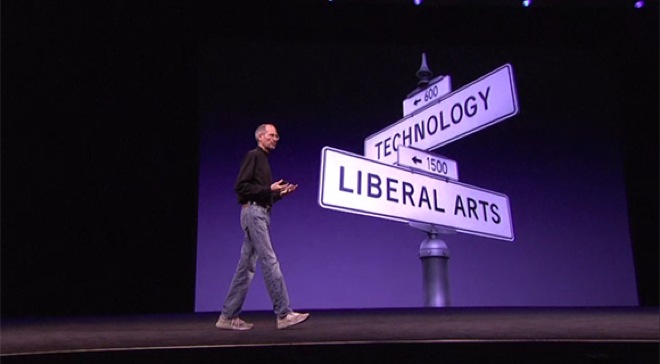
We admire Steve Jobs not just because of the products he built, but also because of the way he articulated the benefits of these products. He showed that technology can be elegant not clunky, beautiful not ugly, sexy not boring. He’s a builder; but above all, he’s a legendary communicator.
“It is in Apple’s DNA that technology alone is not enough—it’s technology married with liberal arts, married with the humanities, that yields us the results that make our heart sing.”

 Zara Zhang